
What makes a knitted sweater hand knitted
In short: A knitted sweater is hand knitted when a person made every loop on needles. Check the seams, edges and yarn joins, pick the fibre for your season, and wash it by hand.
Most of us own a knitted sweater or three, and most of us have never been told how one is made. That’s a pity. Once you know what you’re looking at, you can read a sweater like a page: where it was shaped, where the maker stopped, where they joined a new ball of yarn.
If you’d like to see the stitches done slowly, the free first-lesson videos at Handknit India walk through casting on, the knit stitch and the purl stitch. There is also a free Saturday online session for project questions. Everything below works without them, though.
Here’s the plain answer to the plain question. A hand-knitted sweater is made with two needles (or a circular one) and one working loop at a time. A person holds the yarn, pulls each new loop through the last, and does it again. Thousands of times. Our own about page says it best: “It was made by a hand, not a machine.”
That’s the whole difference, and it’s why two hand-knitted sweaters from the same pattern are never quite twins. The tension of one pair of hands is a little looser on a Tuesday evening than on a Sunday morning. You can see it if you look. We think that’s the charm of it: you’re wearing a piece that one person made, not one of a pile.
It also means a hand-knitted sweater takes the time it takes. We don’t sell it on speed, and you shouldn’t be asked to care about it. Care about the fit, the fibre and the finish instead. That’s what the rest of this guide is for.
How a knitted sweater is built
A sweater isn’t one long piece of fabric. It’s a few shapes that fit together. Knowing them helps you judge a finished one and, later, follow a pattern.
Most sweaters have a front, a back and two sleeves. Each starts at an edge, usually the bottom hem or the cuff, with a ribbed band that pulls in snugly. Rib is made by alternating knit and purl stitches, and it springs back, which is why you find it at cuffs and hems. Above the band, the body runs in plain knitting (the flat, smooth V-shaped fabric most people picture) or in a texture or pattern.
Then comes shaping. The sleeves widen from the cuff to the upper arm by adding stitches. The armholes and neck curve in by taking stitches away. Each of these is a small decision, made row by row.
There are two common ways to put the pieces together.
Seamed. You knit the front, back and sleeves flat, then sew them up. The seams sit on the shoulders and down the sides, and they do real work: they hold the shoulder in place and stop it from stretching under its own weight.
Seamless. You knit the body in the round on a circular needle and the sleeves the same way, then join them at the yoke and work the shoulders down to the neck. There’s less sewing, and the fabric has no side seam. Raglan and top-down sweaters are usually made like this.
Neither is better. A seamless sweater is lovely to wear and easy to try on as you go. A seamed one holds a crisp shape, and for a heavy cable pattern that shape matters.

Aran and Fair Isle, in one breath
You’ll see these two names on a lot of labels, and they mean very different things.
An Aran sweater is about texture. A traditional one is usually off-white, with cable patterns on the body and sleeves, and it usually features 4–6 texture patterns, each about 5–10 cm wide. Aran knitting itself dates only from the 1890s and early 1900s, which surprises people who’ve been told it’s ancient. A cable is just stitches crossed over each other so they twist like a rope.
Fair Isle is about colour. It’s made by carrying two colours along a row, one after the other, to make small repeating motifs. Remember it this way: Aran is cables in one colour, Fair Isle is patterns in several.
Five things to check before you buy
You can’t hold a sweater through a screen, but you can ask for pictures and you can read the description. Here is what to look for. None of these is proof alone. Together they tell you a lot.
Reading the signs on a knitted sweater
| What to look at | In a hand-knitted sweater | What to question |
|---|---|---|
| The stitches | Even, with tiny natural variations in tension | Perfect uniformity across every row, with no variation at all |
| Cable crossings | Each twist sits where the maker put it, so spacing varies a hair | Crossings that look stamped out identically |
| The hem and cuffs | Rib that springs back when you stretch it | Rib that stays stretched out |
| The seams | Stitched by hand, slightly irregular, tidy inside | Seams that are bulky, ragged or loose inside |
| Yarn ends | Woven in neatly on the inside | Ends left hanging or knotted on the outside |
I’d add a sixth, which isn’t about looks. Ask who made it. A real hand-knitted piece has a person behind it, and a good seller can tell you a little about her. “It was made by a hand” should be a sentence that holds up when you ask a second question.
One thing I won’t do is tell you a single clue settles it. Skilled knitters are very even, and that is a good sign, not a suspicious one. Look at everything together, and trust the seller who answers plainly.
Wool, cotton or linen: which fibre for which season
The fibre decides how a sweater feels more than the pattern does. We work in wool, cotton and linen, and each has a place.
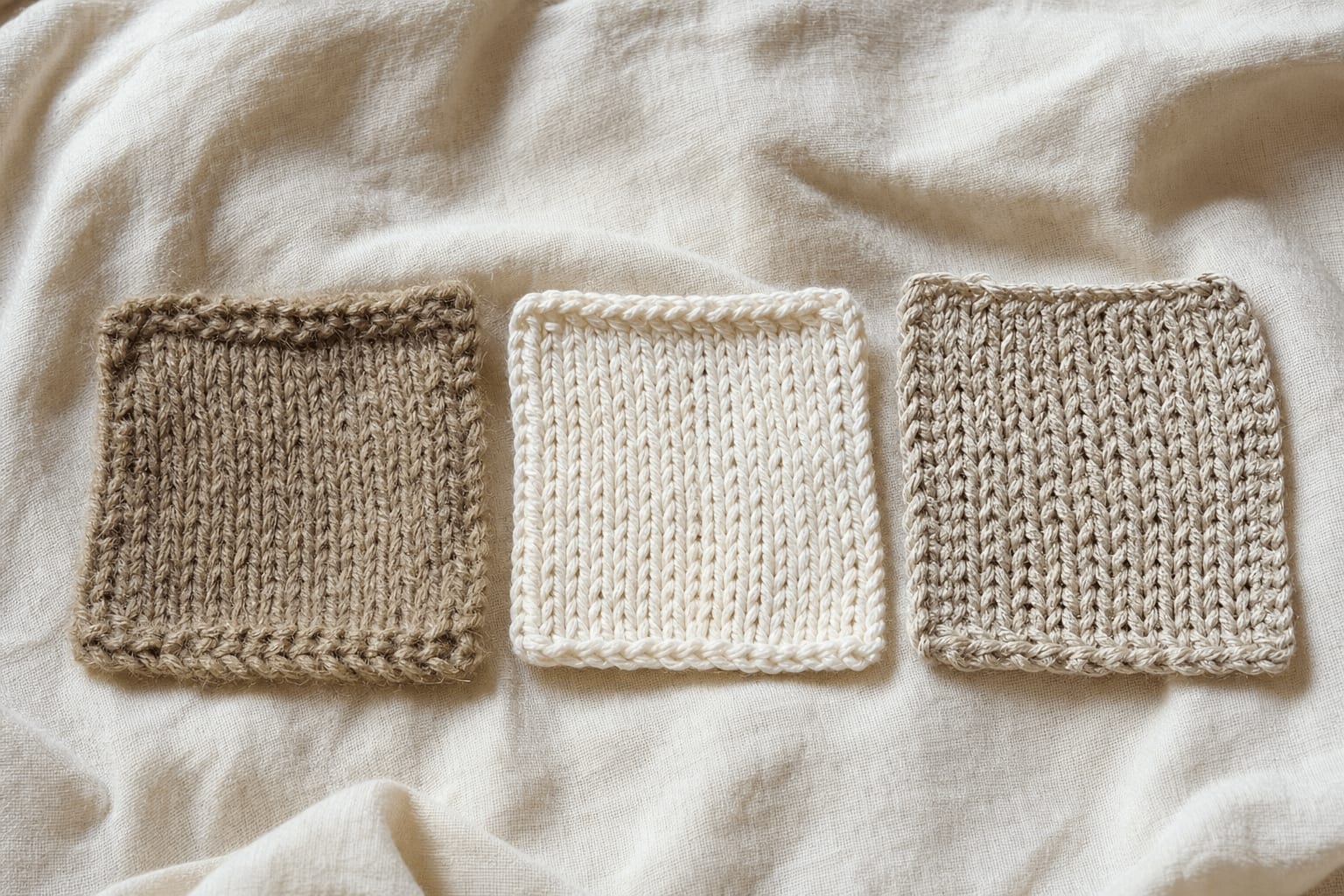
Wool is warm and springy. It holds its shape well. It’s the first choice for a Delhi winter morning, or for hill stations where the evenings drop off. Some people find coarser wool itchy at the neck, so ask if a soft, fine wool has been used and, if you can, try it against your neck.
Cotton is cooler and lies flatter. It doesn’t trap heat the way wool does, which is exactly why it suits the mild days and air-conditioned offices when you still want something over your shoulders. It’s heavier when wet, and a big cotton sweater can stretch with its own weight, so the fit and the stitches matter more.
Linen is the lightest of the three and gets softer each time you wash it. It has a dry, crisp hand when new. It’s the one for warm evenings, and it works best in open, airy stitches.
Which fibre suits which kind of day
| Fibre | Feels like | Best for | Watch out for |
|---|---|---|---|
| Wool | Warm, springy, soft | Cold mornings, hill trips, winter | Itch at the neck with coarse wool, shrinking if washed hot |
| Cotton | Cool, smooth, flat | Mild days, offices with cooling | Stretching under its own weight |
| Linen | Light, dry, airy | Warm evenings, open stitches | Stiff when new |
A note on blends: yarn makers also spin cotton with linen or with bamboo, and some knitters like how those drape. If a label doesn’t tell you the fibre, ask. It’s a fair question, not a rude one.
Fit: how a knitted sweater actually sits
Knitted fabric stretches. That’s a gift and a trap. A sweater that looks small on the table often fits well, and one that looks right can droop after a day.
Two ideas help.
The first is ease. That’s the gap between your body and the garment. A close fit has almost none. A relaxed one has a lot. Pick the ease you like, then look at the measurement across the chest, not the size on the label. Sizes on knitwear drift from one maker to the next, so the flat chest width is the only figure you can compare honestly.
To compare honestly, take a sweater you already love, lay it flat on a bed, and measure it across the chest from one side seam to the other, just under the armholes. Write that number down. Now you have a figure of your own, and a sweater from any maker either matches it or it doesn’t. You’re no longer guessing at a letter on a label, and no size chart is “wrong” for you. The chart simply isn’t talking about your body.
The second is gauge. It’s how many stitches fit in a stretch of fabric, and it decides the size of every sweater you’ll ever knit. A knitter makes a small swatch first, measures it, and only then casts on.
Here is the idea with round numbers, purely as an example. Say your swatch gives 20 stitches across 10 cm. You want a sweater 100 cm around the chest. That’s 10 swatches wide, so 200 stitches. Now suppose your stitches are a little bigger than the pattern writer’s, so your swatch spans more than 10 cm for the same 20 stitches. The same 200 stitches then give you a sweater that is far too wide, and you won’t know until the rows are done. It’s the saddest way to lose a month of evenings. This is why pattern writers say, loud and often, to follow the gauge stated in the pattern, and why a swatch is worth the dull half hour. The Craft Yarn Council puts it in the same words: “Always follow the gauge stated in your pattern.”
Yarn weight and needle size
Yarn comes in thicknesses, and the Craft Yarn Council groups them into categories with a usual gauge and a usual needle size for each. Their own table calls these guidelines only, so treat them as a starting point.
Three yarn categories most sweaters use
| Category | Stockinette gauge (stitches per 4 in) | Usual needle (mm) |
|---|---|---|
| Light | 21–24 | 3.75–4.5 |
| Medium | 16–20 | 4.5–5.5 |
| Bulky | 12–15 | 5.5–8 |
Source: Craft Yarn Council, standard yarn weight system
See the pattern in the numbers. Thicker yarn means fewer stitches to the same width and a bigger needle. A chunky sweater has fewer, bigger loops than a fine one. That’s all. It doesn’t turn a quiet craft into a race, and a fine-gauge sweater isn’t a better one. It simply asks for more loops and more evenings, and gives you a thinner, closer fabric in return.
Washing a hand-knitted sweater
This is the part most buyers worry about, and it’s the part where the sweater is least forgiving. Always read the care label first. If a piece has none, which happens with hand-knitted pieces, use the gentlest method.
For a wool sweater, Woolmark gives a short hand-wash routine:
- Fill a tub with clean water at a lukewarm temperature.
- Add a wool detergent, ideally a Woolmark-approved one.
- Soak the sweater for 10 minutes.
- Rinse thoroughly in lukewarm water.
- Rinse again in cold water.
Then comes the drying, which matters just as much. Woolmark says that knitwear such as sweaters “should be flat-dried in the shade”, and flat unless the care claim says it can be tumble dried. So no hanger. A wet sweater on a hanger sags at the shoulders and grows long. Lay it on a clean towel, shape it gently by hand back to its size, and leave it alone.
A few points from our side, as common sense rather than a rule from the page above. Don’t twist or wring: press the water out in a towel instead. Don’t use hot water on wool. Dry it out of direct sun. In an Indian monsoon, flat drying takes patience, so give it a day in a room with a fan rather than rushing it near a heater.
Cotton and linen are sturdier. Even so, a gentle hand wash and a flat dry keep the shape, and keep the stitches from stretching.
Storage is the other half of care. Fold a knitted sweater and lay it in a drawer or on a shelf. Hanging pulls the shoulders down over the months, much as a wet hanger does in an hour. Before you put wool away for the summer, wash it, let it dry fully, and make sure it is not damp when it goes in. If you’re not sure how a particular yarn will behave, wash a small swatch or an unseen corner first, and watch what happens before you wash the whole piece.
One more thing. If you bought a customised or made-to-order piece from us, our return policy treats it differently from a ready item, and a washed piece is not eligible for return. Wash it only once you’ve decided to keep it.
If you want to knit one yourself
Could you? Yes. I’d say start smaller than a sweater, but a sweater is not out of reach for anyone who likes quiet hours and is willing to unravel a few rows.
A realistic path looks like this: learn to cast on, to knit and to purl. Make a scarf or a small flat piece. Then make a swatch and measure it, the way we described above. Then try a simple sweater, the kind with a plain body and a ribbed band.
The Learner Kit at Handknit India comes with yarn, knitting needles, a crochet hook, scissors, a sewing needle, a measuring tape and printed patterns for ten beginner projects. It isn’t a finished garment, and it doesn’t include one. It’s the things you’ll need to make something yourself. Our free lessons cover five beginner knitting projects and five beginner crochet projects, and we teach needle-based hand knitting only.

When a mistake happens (it will), don’t panic and don’t feel bad. Dropped stitches, twisted loops, a sleeve one row too long: every knitter has done them all. The fix is nearly always to unpick back a few rows and carry on. Patience is a part of the craft, not a punishment for being new.
Frequently asked questions
What is a knitted sweater?
It’s a sweater made of loops of yarn pulled through each other, rather than threads woven across each other. That structure is what makes it stretch and spring back. It can be made by hand on needles, and ours are.
How can I tell if a sweater is hand knitted?
Look at the stitches, the seams, the cable crossings and the yarn ends together. Tiny natural variations in tension are a good sign. No single clue is proof, so ask the seller who made it.
What is the best fibre for a knitted sweater?
It depends on the weather. Wool is the warm choice for winter, cotton suits mild days, and linen is the lightest for warm evenings. If you feel itch at the neck, ask for a soft, fine wool.
How do I wash a hand-knitted sweater without shrinking it?
Check the label, then hand wash in lukewarm water with a wool detergent, soak for 10 minutes, rinse in lukewarm water and then cold, and dry it flat in the shade, as Woolmark advises. Avoid hot water and hangers.
What is an Aran sweater?
It’s a textured sweater, traditionally off-white with cable patterns on the body and sleeves. It’s also one of the things we specialise in.
Can a beginner knit a sweater?
Yes, with patience. Learn the knit and purl stitches first, make a swatch to find your gauge, and begin with a simple pattern. Handknit India’s learning page is a good place to start.
Does Handknit India ship outside India?
Our retail delivery is within India only, as our FAQ says.
